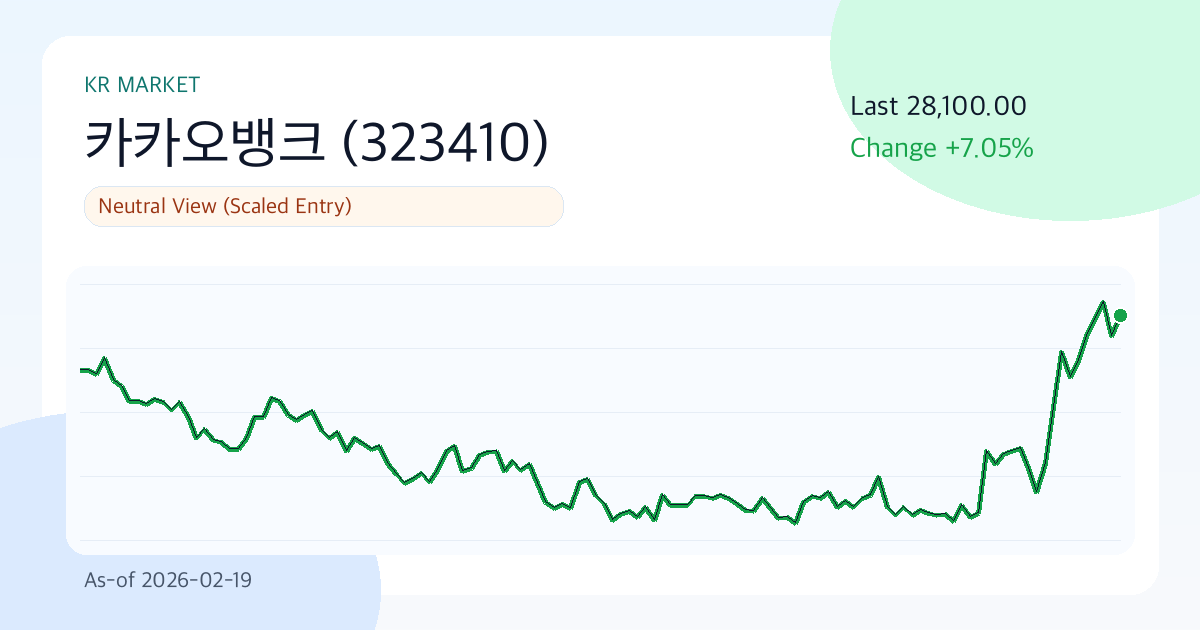
[The Market's Bare Face] Kakao Bank: Walking the Tightrope Between a Blocked Ceiling and a Solid Floor (As-of: 2026-02-19)
[The Market's Bare Face] Kakao Bank: Walking the Tightrope Between a Blocked Ceiling and a Solid Floor
1. The Valuation Trap: The Optical Illusion of Record-Breaking Earnings
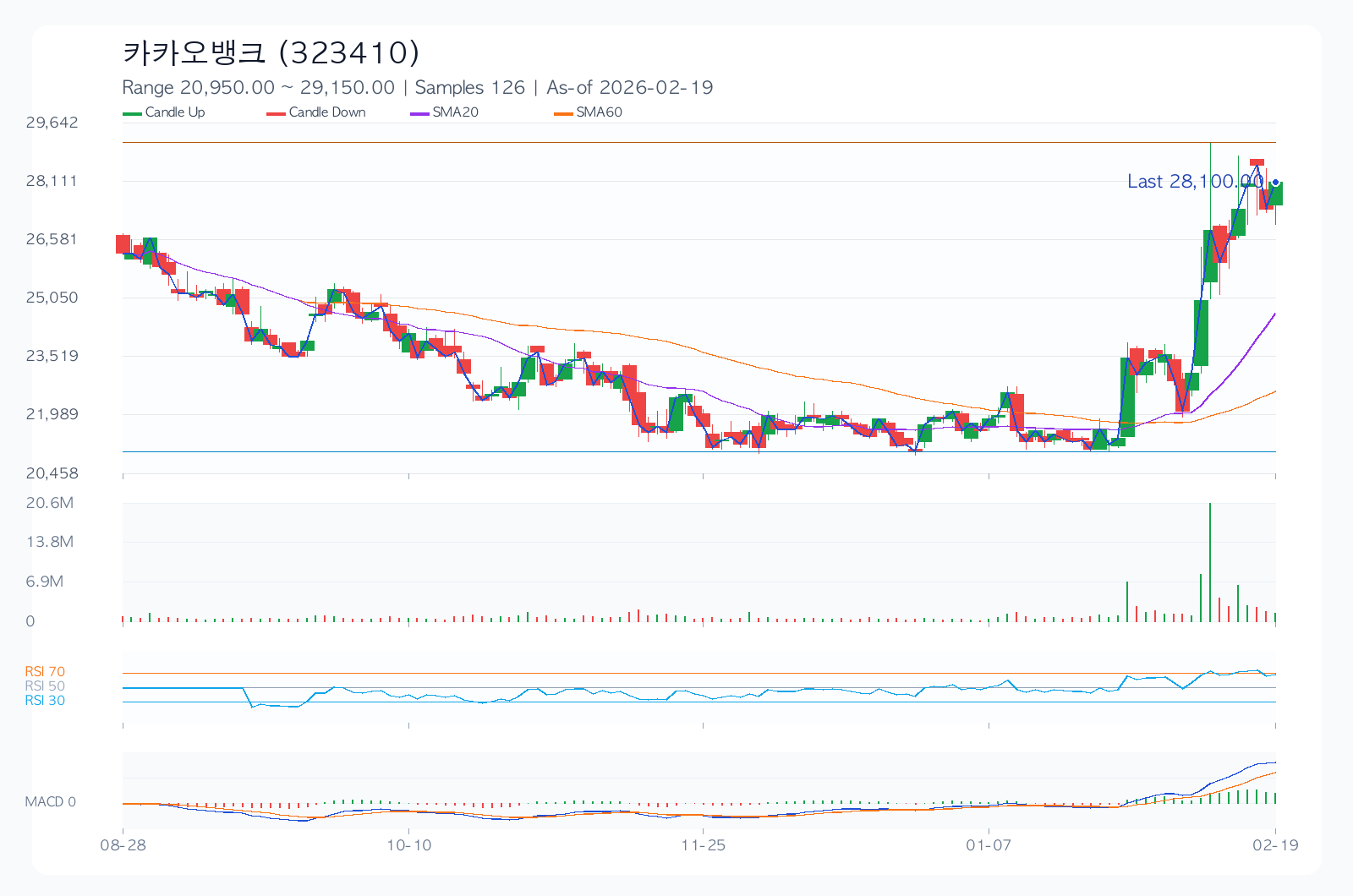
Let's close the order book for a second and look at the cold, hard facts. Surpassing 480 billion KRW in annual net profit for 2025, double-digit growth in both loans and deposits. Looking purely at the surface-level report card, your hand should instinctively reach for the 'Buy' button. But look at the price today (Feb 19). It's stuck around the 28,000 KRW mark, struggling to break through the ceiling. (Sure, it barely escaped the humiliating bottom of the 22,000 KRW range, but the market's gaze remains freezing cold.)
Why is it so thoroughly alienated? Because the market is interpreting Kakao Bank's numbers not as 'structural growth,' but as 'squeezing out every last drop of blood.' The P/B ratio (Price-to-Book) still hovers above 2.0x, while commercial banks are flying toward the 1.0x mark thanks to the Value-up Program. Faced with the heavy question of "Does Kakao Bank still possess something so overwhelmingly superior that it deserves a 2-3x premium over traditional banks?", the buyers have simply snapped their wallets shut. This is the psychological essence behind the grotesque mispricing between the stellar earnings and the stagnant stock price.
2. The Unreplicable Moat: The Magic of '1% Funding Cost' Trapping 26 Million Wallets
The only reason I'm not telling you to short this stock and walk away is because of the overwhelming cost competitiveness hidden deep within its financial statements.
- The Power of CASA (Core Deposits) at 50%: While commercial banks are bleeding interest expenses by issuing high-rate promotional deposits, Kakao Bank's funding cost ratio maintains a near-miraculous mid-to-high 1% range. The secret lies in their 'Moim (Group) Accounts' and 'Parking Accounts'. CASA—money that yields almost zero interest to the customer—makes up more than half of their total deposit balance. The pocket change left behind daily by their 26 million MAUs (Monthly Active Users) accumulates into free ammunition that competitors couldn't replicate even if they tried.
- The Cogwheel That Turns Without Loans: Look at the qualitative growth in fee and platform revenue (non-interest income). The volume of linked brokerage accounts, affiliate loans, and co-branded credit cards prints cash every single quarter. This is their last remaining pride as a platform company, allowing them to defend their ROE without aggressively expanding their loan book (and taking on more risk).
3. X-Ray of the Risks: The Bill for Being the 'Good Bank' Dictated by the State
Now it's time to face reality. What the market fears isn't just temporary noise; these are signs of a structural collapse eating away at the balance sheet.
- The Counterattack of Credit Costs (The NPL Warning): Shackled by its founding mandate as an internet-only bank, Kakao Bank is forced to maintain over 30% of its loan portfolio for mid-to-low credit borrowers. Prolonged high interest rates have caused borrowers in this segment to crack first, and the delinquency rate is creeping up, threatening the 0.5% line. The profits they earned are turning into a bottomless pit as they spit them back out as loan loss provisions.
- The Mortgage Brakes and the Regulatory Dilemma: What drove their 2024-2025 earnings was, ironically, traditional mortgage loans. However, the financial authorities, desperate to manage household debt, have drawn their swords, accusing internet banks of taking the easy route by peddling mortgages. They are being forced into a deformed race where the government is slamming the accelerator with one foot (mandatory low-credit lending) and stomping on the brakes with the other (mortgage volume quotas). The engine of growth has been forcibly shut down.
4. The Action Plan: The Floor is Confirmed, but the Ceiling is Shut
Standing in front of this complex equation, anyone telling you to "go all-in blindly tomorrow" is a fraud. You have to leave the top and bottom open and survive through strict band play.
1) The Buy Zone (Entry Band)
- Target Range: 24,500 KRW ~ 26,000 KRW
- The Logic: Above 28,000 KRW is a dead zone where trapped investors are just waiting to dump their bags and escape. The real opportunity comes when the stock takes another dive on bad news like further government lending curbs or a spike in delinquency rates. The 25,000 KRW mark is a concrete floor where downside rigidity is secured strictly by the book value (BPS) of a pure banking business, stripping away the 'platform' label completely. If you scale in here, it's very hard to lose.
2) The Sell Signal (Liquidation Trigger)
- The Condition: Don't obsess over a fixed 'target return' number. Use the news headlines hitting the portal front pages as your exit signal.
- When 'growth stories' like the resolution of Kakao Group's legal risks or "tangible profits from overseas expansion (e.g., Southeast Asia)" dominate the media and trading volume explodes, that's your cue to hand over your shares.
- On the chart, the 32,000 KRW ~ 34,000 KRW range is the 'wailing wall' for retail investors who have been trapped for years. Once you enter this zone, drop the greed and scale out to lock in profits. It's better for your mental health.
3) The Stop-Loss Scenario
- The Price: Clean break below 21,000 KRW
- The Logic: If this support crumbles, it's not just a temporary supply-demand twist. This is a price you only see when a fatal internal injury is confirmed—like a declining MAU trend or negative growth in platform fee revenues. If this line breaks, you must accept the market's death sentence that "the growth story is officially dead." Admit your thesis was wrong, cut your losses, and walk away without looking back.
5. The Bottom Line (TL;DR)
- Despite record-breaking profits, the stock is being crushed because the market is hyper-focused on the regulatory stranglehold ('low-credit lending quotas' and 'household debt suppression') that has blocked its growth ceiling.
- However, the overwhelmingly low funding costs (CASA) and the deeply loyal 26 million platform traffic serve as a massive shield preventing a total collapse.
- Chasing the rally at current prices is strictly for amateurs. Stick to a ruthless box-trading strategy: scoop it up when regulatory fears push it down to the mid-20,000s, and dump it when platform-related good news pushes it into the 30,000s.
This briefing is a personal scenario based on actual financial data (funding structure, NPL ratios) and market psychology as of February 19, 2026. The ultimate responsibility for any investment lies entirely at the tip of the finger that clicks the mouse.
[Reference Data & Verification Links]
- Real-time Price & Institutional Flow: Naver Pay Finance - Kakao Bank (323410) Live Data
- Financial Statements & Metrics (NIM, Delinquency Rate, CASA %): Kakao Bank IR Official Page - FY2025 Earnings Release
- Market Trends on Regulatory Risks: Naver News - 'Internet Bank Loan Regulations' Search Results
Related Reports
Recent notes from the same market to compare assumptions.
- Naver (035420) KRW 254,500 | 3-Month +2.2% | Volatility 43.9% | Entry Timing Check Zone (As of: 2026-02-20) (As-of 2026-02-20)
- Grand Korea Leisure (114090) 13350.00 | 3M -6.1% | Vol 26.7% | Entry Timing Check Zone (As of: 2026-02-20) (As-of 2026-02-20)
- SK Hynix (000660) 949000.00 | 3M +66.5% | Vol 61.5% | Momentum Check Phase (As of: 2026-02-20) (As-of 2026-02-20)
- Samsung Electronics (005930) ₩181,200 | 3-Month +86.4% | Annualized Volatility 55.1% | Entry Timing Check Zone (As of: 2026-02-13) (As-of 2026-02-13)