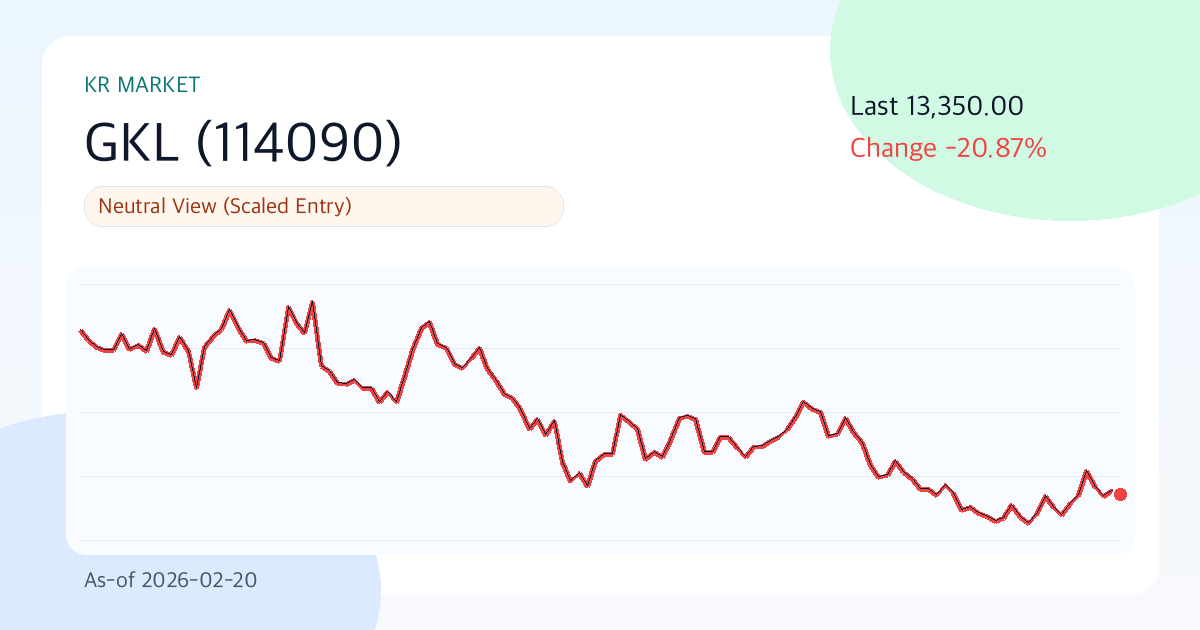
Grand Korea Leisure (114090) 13350.00 | 3M -6.1% | Vol 26.7% | Entry Timing Check Zone (As of: 2026-02-20)
Summary
- One-Line Judgment: Neutral Outlook (Phased Approach)
- Confidence Level: High
- Comment: Grand Korea Leisure (114090) is currently at 13350.00 KRW, with a 3-month return of -6.1%. Amidst an annualized volatility of 26.7%, managing the price level between the short-term support (12730.00 KRW) and resistance (14050.00 KRW) is crucial. It's time to set clear entry/exit conditions, keeping in mind the possibility of a 1-2 quarter re-rating.
Key Points (3 Lines)
- The key point for this period is whether the price remains above the 20-day moving average (13113.50 KRW). If it does, short-term supply and demand are likely to be favorable.
- The combination of a 15.8% margin and 12.4% ROE signals that the core business strength is not weak, but the D/E ratio of 0.16 requires checking interest rate sensitivity as well.
- Based on a dividend yield of 4.8% and an average dividend payout ratio of 32.8%, dividend sustainability is rated as 'Good'.
Looking at Grand Korea Leisure's chart today, the first thing that stands out is rhythm rather than numbers. While headwinds are currently dominant, the possibility of a directional change remains open. Therefore, it is more advantageous to first determine 'under what conditions the judgment will change' rather than rushing to a conclusion.
Investment Thesis (Value)
The core of this period lies in whether growth and profitability are maintained simultaneously. If the quality of Grand Korea Leisure's earnings remains stable and the market's valuation (PER 12.1, PBR 2.0) does not excessively decline, the current valuation will gain explanatory power over time.
The core thesis is whether the combination of 'financial strength (15.8% margin, 12.4% ROE) and current price momentum (3-month -6.1%)' can lead to a re-rating in the next 1-2 quarters.
- Growth: A revenue growth rate of 16.7% indicates a phase of top-line expansion.
- Profitability: An operating profit margin of 15.8% and ROE of 12.4% are interpreted as within the normal range or at the lower end.
- Valuation: PER of 12.1 and PBR of 2.0 are classified as neutral to reasonable.
- Cash Return: The combination of an average dividend payout ratio of 32.8% and a dividend yield of 4.8% is positive for shareholder return attractiveness.
Unique Argument of This Report (Basis)
- The primary basis for the current judgment is the supply and demand directionality created by the recent 3-month return of -6.1% and the price's position relative to the 20-day moving average (13113.50 KRW).
- Financial strength is assessed through an operating profit margin of 15.8% and ROE of 12.4%. If both of these values decline sharply, the quality of the investment thesis will rapidly weaken.
- The valuation metrics are PER of 12.1 and PBR of 2.0. The core of this report is whether 'this valuation is excessive compared to the growth rate of 16.7%'.
Technical Analysis
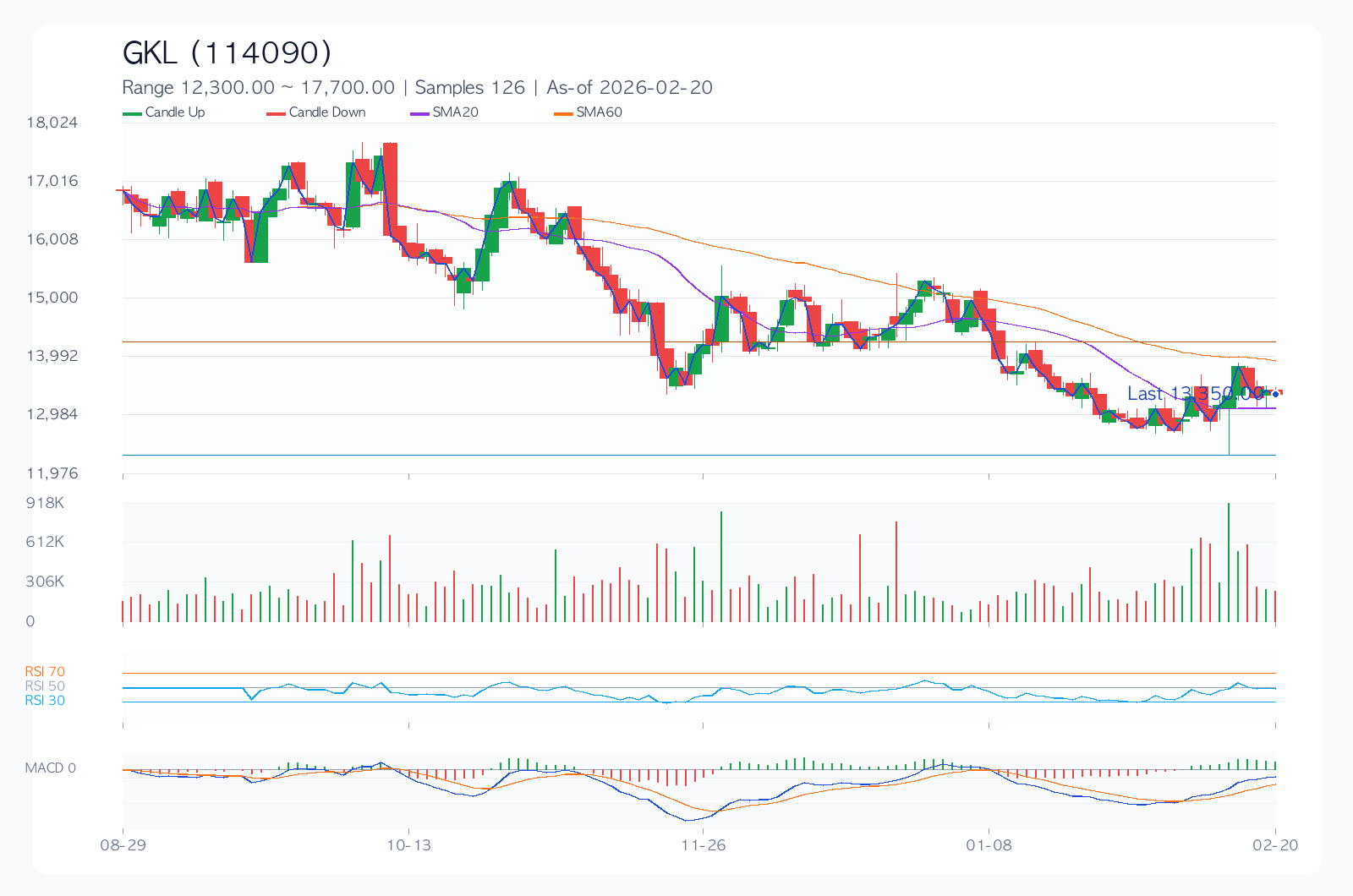
Technically, this is a juncture where conviction and doubt coexist. Therefore, level management (support 12730.00 KRW / resistance 14050.00 KRW) is likely to account for most of the performance, rather than chasing the price.
- Trend: The 20-day/60-day/120-day moving averages are 13113.50/13941.00/14916.33 KRW, showing a mixed or inverse arrangement.
- Momentum: 1-month -0.07%, 3-month -6.05%, 6-month -20.87%, indicating directional uncertainty.
- Overbought/Oversold: RSI(14) is 57.66, which is in the neutral zone.
- Volatility/Drawdown: 30-day annualized volatility of 26.65% and maximum drawdown of -27.91% should be used as benchmarks for position sizing.
- Price Levels: A trend reversal is likely when the short-term support at 12730.00 KRW or resistance at 14050.00 KRW is broken or breached.
Desk Memo (Light Comment)
While not a dramatic market, adhering to rules in these everyday market conditions is what ultimately creates performance.
Key Chart
Financial Statements & Indicators
| Category | Value |
|---|---|
| Overall Score | 66.5/100 |
| Value/Technical/Risk | 66.2 / 47.9 / 100.0 |
| Current Price | 13350.00 |
| 1M/3M/6M Return | -0.1% / -6.0% / -20.9% |
| 30-Day Annualized Volatility | 26.6% |
| Max Drawdown (MDD) | -27.9% |
| 52-Week Range | 10660.00 ~ 17490.00 |
| 20/60/120-Day MA | 13113.50 / 13941.00 / 14916.33 |
| RSI(14) | 57.7 |
| Short-term Support/Resistance | 12730.00 / 14050.00 |
| Revenue Growth Rate | 16.7% |
| Operating Profit Margin | 15.8% |
| ROE | 12.4% |
| D/E | 0.16 |
| PER / PBR | 12.1 / 2.0 |
| Dividend Yield | 4.8% |
Dividends (History/Sustainability)
More important than the yield itself is whether the policy is maintained even when the economy and earnings fluctuate. The current assessment is 'Good'.
| Year | DPS | Payout Ratio |
|---|---|---|
| 2022 | 0.00 | 32.8% |
| 2023 | 353.00 | 32.8% |
| 2024 | 60.00 | 32.8% |
| 2025 | 282.00 | 32.8% |
Investment Guru Perspective Simulation
The following content is not a reproduction of actual guru trades, but a style simulation applying the core questions of each investment philosophy to the current data.
| Perspective | Style Score (0-100) | Current Focus | Hypothetical Action Scenario |
|---|---|---|---|
| Warren Buffett (Quality/Margin of Safety) | 47.1 | ROE 12.4%, Operating Margin 15.8%, D/E 0.16, PER 12.1 | Quality confirmed, but insufficient price margin of safety; holding off. |
| Peter Lynch (Growth/Price Balance) | 63.1 | Revenue Growth 16.7%, PEG Ratio ~0.72, 6-Month Return -20.9% | Small tracking position until growth sustainability is confirmed. |
| George Soros (Trend/Reaction Speed) | 45.2 | 1M/3M Return -0.1%/-6.0%, Volatility 26.6%, RSI 57.7 | Low trend conviction; observing until signals appear, only reacting to reversal signs. |
Key Risks
Responding to bad scenarios is more important than good ones. For Grand Korea Leisure, the risk statement now serves as a safety net for maintaining a position rather than a warning. In the current phase, changes in valuation metrics (PER 12.1, PBR 2.0) and 30-day annualized volatility (26.7%) can significantly influence the speed of downside risk.
- Changes in consensus and guidance comments before and after earnings announcements can influence short-term direction.
- Valuation frameworks can rapidly change due to regulatory, litigation, or policy shifts (trade/antitrust/financial regulations, etc.).
- Competitive intensity in the core business may weaken market share and profit margin defense capabilities.
- Changes in exchange rates and macroeconomic variables (interest rates/economy) can simultaneously impact earnings and valuation.
Counterarguments and Invalidation Conditions
The counterargument is that 'valuation burden (PER 12.1, PBR 2.0) or demand slowdown, if confirmed, could lead to multiple compression faster than earnings improvement.'
- If the price remains below the short-term support of 12730.00 KRW for more than two weeks, the current trend assumption is considered invalid.
- If the next quarter's revenue growth slows to below 13.7%, the growth assumption needs re-evaluation.
- If the consensus EPS is revised downwards for four consecutive weeks after the earnings announcement, the base scenario will be adjusted downwards.
Checklist
Must-See Before Next Disclosure/Earnings
- Confirm if revenue growth rate is maintained at 14.7% or higher in the next quarterly earnings.
- Confirm if the stock price defends the short-term support level of 12730.00 KRW.
- Confirm if consensus EPS estimates are revised upwards for four consecutive weeks.
Portfolio Management Notes
Volatility is not in an overheated zone, but the magnitude of price swings around events remains significant. Given the neutral stance, an approach that prioritizes setting conditional entry criteria over directional bets is rational.
Pre-Decision Check
- Have the direction of consensus EPS for the next two quarters (upward/downward) been checked?
- Can the financial structure (D/E, interest coverage, cash flow) withstand an economic slowdown?
- Does the entry price secure a risk-reward ratio of at least 1:2 compared to support/resistance levels?
- Are dividend policies (increase/maintain/decrease) and share buyback policies consistently followed?
- Has the maximum acceptable loss limit in case of a pessimistic scenario been pre-defined?
Conclusion (Optimistic, Base, Pessimistic 3 Scenarios)
| Scenario | Assumption | Key Trigger | Target Price (Model) | Expected Return |
|---|---|---|---|---|
| Optimistic | Simultaneous earnings surprise and multiple defense | Accelerating revenue growth + upward guidance revision | 15629.10 | 17.1% |
| Base | Earnings meet consensus, multiples remain neutral | Margin defense + neutral supply/demand | 13954.55 | 4.5% |
| Pessimistic | Simultaneous earnings slowdown and multiple contraction | Downward guidance revision + increased risk premium | 11442.73 | -14.3% |
The target price for the base scenario is 13954.55 KRW. However, given the wide gap between the optimistic (17.1%) and pessimistic (-14.3%) scenarios, it is reasonable to view this stock as being in a phase where 'conditional response' is more important than finding the 'correct answer'.
Data Sources
- Data As of:
2026-02-20 - Report Generated On:
2026-02-22 - Original Stock Link: https://finance.yahoo.com/quote/114090.KS
- Source Data: Yahoo Finance Price/Quote
Related Reports
Recent notes from the same market to compare assumptions.
- Naver (035420) KRW 254,500 | 3-Month +2.2% | Volatility 43.9% | Entry Timing Check Zone (As of: 2026-02-20) (As-of 2026-02-20)
- SK Hynix (000660) 949000.00 | 3M +66.5% | Vol 61.5% | Momentum Check Phase (As of: 2026-02-20) (As-of 2026-02-20)
- [The Market's Bare Face] Kakao Bank: Walking the Tightrope Between a Blocked Ceiling and a Solid Floor (As-of: 2026-02-19) (As-of 2026-02-19)
- Samsung Electronics (005930) ₩181,200 | 3-Month +86.4% | Annualized Volatility 55.1% | Entry Timing Check Zone (As of: 2026-02-13) (As-of 2026-02-13)